
iFixit rates iPhone 18 Pro repairability
iFixit specialists disassembled the iPhone 18 Pro and 18 Pro Max and preliminarily rated their repairability at 7 out of 10. Inside, they found both successful solutions such as a screw-mounted battery and modular cameras, as well as new issues.
Screen removal
Most components of the iPhone 18 Pro and 18 Pro Max remain accessible only after removing the display. The rear glass panel can also be disassembled, but from that side, the only actually serviceable component is the wireless charging coil.
Removing the display turned out to be the most problematic part of the disassembly. In all four cases, the panels themselves remained functional, but in three of them, the white plastic frame cracked or partially detached. This frame is part of the display module, so simply replacing the adhesive after such damage is insufficient. Additionally, the smartphone’s water resistance may degrade after reassembly.

iFixit has not yet determined the exact cause of the issue. Potential factors include the properties of the adhesive and plastic, the disassembly technique, and a more efficient cooling system that may draw heat away from the device edges and hinder adhesive softening. The only display removed without damage was heated for 15 minutes at 70 °C, followed by an additional 10 minutes at 72 °C. Four devices are insufficient to judge how widespread the problem is.
Battery removal
After removing the display, replacing the battery has become significantly easier. Apple retained the metal tray introduced in the previous generation: the battery is secured to it with 13 screws and can be removed as a single unit without struggling with adhesive tapes.

The battery is still glued to the tray, but it uses an adhesive that weakens under electrical current. In iFixit’s test, the battery separated in about 90 seconds at 12 V.
In tested versions without a physical SIM slot, the iPhone 18 Pro battery capacity is 4288 mAh (16.76 Wh), and the iPhone 18 Pro Max is 5567 mAh (21.751 Wh). Models with a physical SIM card have smaller batteries.
Cooling system and motherboard
Apple has significantly redesigned the system board layout. The A20 Pro is now positioned on the outer side of a two-layer board, with RAM located next to the processor. This configuration creates a more direct heat dissipation path to the vapor chamber.

According to Apple, the surface area of the evaporative chamber has tripled compared to the previous design. A compliant thermal interface is placed between the A20 Pro and the cooling system to ensure tight contact between components.
However, the new layout created a fresh challenge for complex repairs. The NAND flash memory is now located inside a two-layer system board. To access the chips, technicians must separate the board layers with additional heating, which increases complexity and the risk of damaging components.

This is especially important when recovering data. Due to encryption, information cannot be retrieved by simply moving NAND chips to another smartphone. Typically, specialists restore the original motherboard to a state where the device can boot again, while access to the storage chips themselves has become more difficult.
USB-C and Face ID
The USB-C port remains a separate replaceable component, but accessing it is not easy. A long ribbon cable runs along the chassis to the system board, and access is blocked by screws, adhesive, and other parts. Therefore, replacing the port remains labor-intensive.
In contrast, the front camera module is much easier to remove: it detaches without screws or adhesive.
The teardown also revealed how Apple reduced the Dynamic Island. The Face ID infrared camera is now located under the display to the left of the central cutout, while the front-facing camera and dot projector remain inside it. Every other row of OLED pixels above the IR camera has been removed, allowing infrared light to pass through the screen. Under the display, iFixit also found an element resembling an infrared filter.
Camera with variable aperture
The main camera features a mechanical aperture with six overlapping blades made of polymer composite. Their thickness is comparable to a human hair, and movement is achieved via a magnetic mechanism.

The standard camera app offers four aperture values: f/1.48, f/1.8, f/2.8, and f/4.0.
iFixit disassembled the mechanism under a microscope. During lens removal, miniature blades popped out of their guides, making it extremely difficult to restore the mechanism to its original state. Due to very tight tolerances, adhesive, and complex construction, repairing the aperture at the component level is practically impossible.
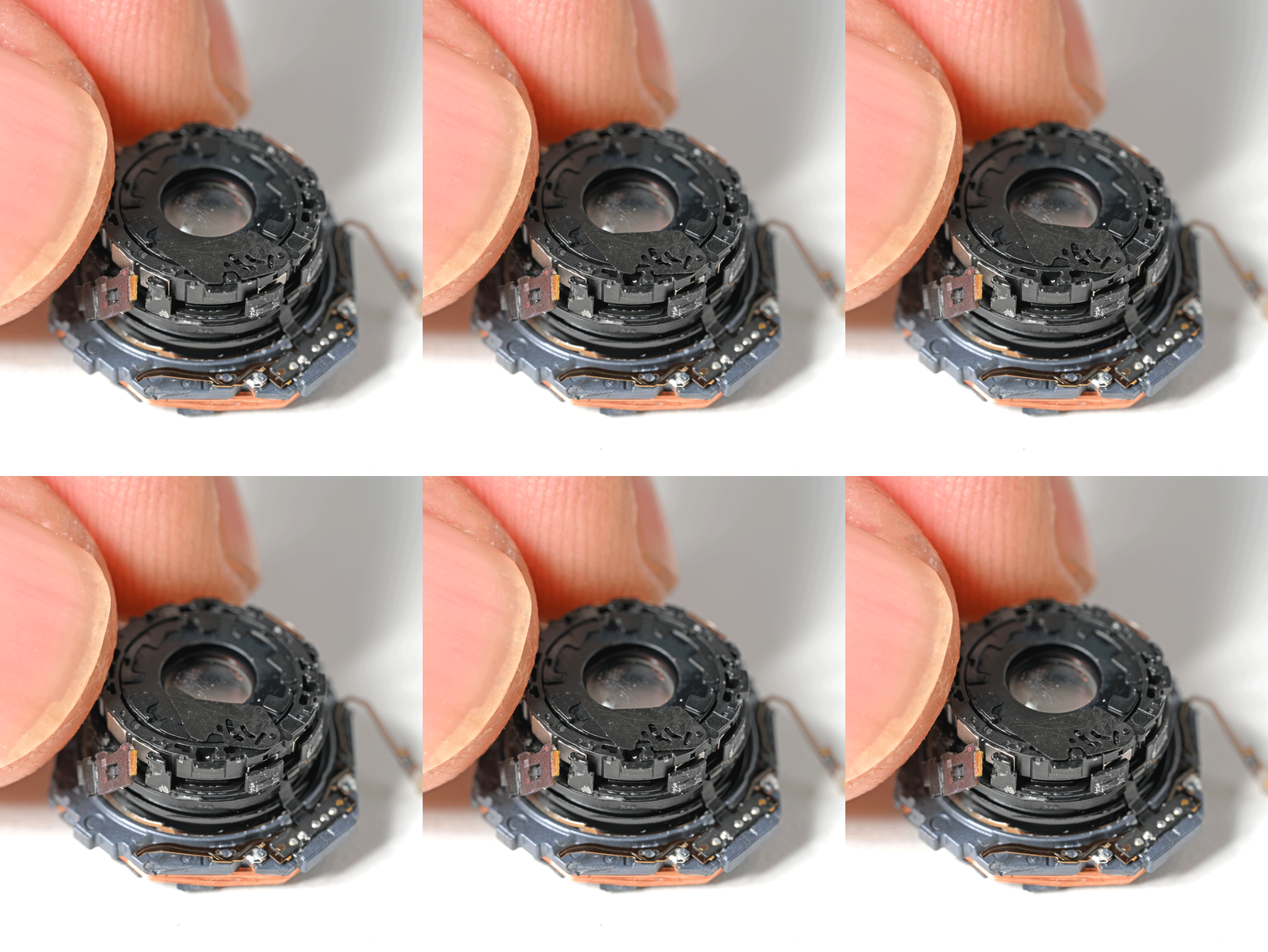
At the same time, the camera is built as a separate module and can be relatively easily replaced as a whole. Apple has not yet published the price for the iPhone 18 Pro camera, but for comparison, the iPhone 17 Pro camera kit in the self-repair program costs $249.
Conclusion
iFixit preliminarily rated the repairability of the iPhone 18 Pro and iPhone 18 Pro Max at 7 out of 10. The battery tray on screws, modular camera construction, and Apple’s repair infrastructure were noted as positives.
The main drawback is that almost any serious repair begins with removing the glued display. Additional challenges include NAND on a two-layer system board, an inaccessible USB-C port, and a variable aperture mechanism that is nearly impossible to repair.
The assessment remains preliminary. iFixit continues to verify the availability of replacement parts, software pairing of replaced components, and the issue with damage to plastic display frames.


